The 12 Best Secrets Management Tools for Secure DevOps in 2026
#devops#cloudsecurity#devsecops#secretsmanagement#securitytools
Discover the best secrets management tools for your engineering team. In-depth reviews of Vault, AWS Secrets Manager, Doppler, and more for 2026.


Hardcoded credentials, API keys scattered across configuration files, and unsecured database passwords are the silent killers of secure software delivery. In modern cloud-native environments, where ephemeral infrastructure is provisioned via Terraform and applications are deployed in containers through CI/CD pipelines, managing these secrets has become a critical, non-negotiable challenge. The old methods of using .env files or encrypted blobs in Git repositories simply don't scale and introduce unacceptable security risks. This is why a dedicated secrets management tool is no longer a luxury, but a foundational pillar of any mature DevOps and security practice.
Finding the right solution, however, is complex. The market is filled with options, each with distinct trade-offs in operational overhead, integration capabilities, and pricing models. This guide is designed to cut through the noise and provide a comprehensive comparison of the best secrets management tools available today. We'll move beyond marketing jargon to deliver actionable insights for engineering leaders, DevOps consultants, and security teams tasked with making this crucial decision.
This article provides an in-depth analysis of 12 leading platforms, from self-hosted powerhouses like HashiCorp Vault to fully managed cloud services like AWS Secrets Manager and developer-focused SaaS solutions like Doppler. For each tool, you will find:
- A concise one-line summary.
- Detailed pros and cons based on real-world usage.
- Ideal use cases for specific environments (e.g., specific cloud providers, scale, or compliance needs).
- Key integration notes covering Kubernetes, Terraform, and IAM.
- Practical pricing and operational considerations.
Our goal is to equip you with the detailed information needed to select the secrets management platform that best fits your team's workflow, technical stack, and security requirements.
1. HashiCorp Vault
HashiCorp Vault is an enterprise-grade, identity-based secrets management platform that stands out for its flexibility and deep integration capabilities. It secures, stores, and tightly controls access to tokens, passwords, certificates, and encryption keys by enforcing identity-based access. This makes it a top choice among the best secrets management tools for complex, multi-cloud environments.
Its main strength lies in its extensive ecosystem. Vault integrates seamlessly with popular infrastructure-as-code tools like Terraform and container orchestrators like Kubernetes. The platform offers powerful features like dynamic secrets, where credentials are generated on-demand and automatically expire, significantly reducing the risk of a breach. Adhering to strong secrets management best practices is central to its design.
Key Considerations
- Deployment Models: You can opt for a fully managed service via HashiCorp Cloud Platform (HCP) Vault on AWS or Azure, which simplifies operations. Alternatively, self-hosting provides maximum control but introduces significant operational complexity, requiring dedicated expertise to manage clusters, replication, and disaster recovery.
- Pricing Structure: The self-hosted open-source version is free. HCP Vault pricing is based on an hourly cluster fee plus charges per client connection, which can be complex to forecast. Enterprise tiers for both HCP and self-hosted versions unlock features like namespaces for multi-tenancy and advanced replication.
- Use Cases: Vault excels in organizations that are already invested in the HashiCorp ecosystem. It's ideal for regulated industries needing strong audit trails and policy enforcement (via Sentinel) and for teams managing PKI infrastructure or requiring encryption-as-a-service.
Website: https://www.hashicorp.com/products/vault/secrets-management
2. AWS Secrets Manager
AWS Secrets Manager is a fully managed service designed to simplify the lifecycle of secrets for applications running on AWS. It provides a centralized place to store, manage, and retrieve credentials, API keys, and other secrets, with deep, native integration into the AWS ecosystem. This tight coupling with services like IAM for access control and KMS for encryption makes it a default choice for teams heavily invested in AWS infrastructure.
Its primary advantage is its operational simplicity and automated capabilities. The service supports automatic credential rotation for supported AWS services like RDS and Redshift, reducing the manual effort and security risks associated with long-lived secrets. This automated approach is also crucial when implementing strong Docker security best practices where containerized applications require dynamic access to credentials.

Key Considerations
- Deployment Models: As a fully managed AWS service, there is no self-hosting option. It is deployed regionally within your AWS account, offering high availability and durability out-of-the-box. For disaster recovery, secrets can be replicated to other AWS regions, providing resilience for multi-region applications.
- Pricing Structure: The pricing is straightforward and usage-based. You pay a monthly fee per secret stored and an additional charge per 10,000 API calls. This pay-as-you-go model is cost-effective for small to medium workloads but requires monitoring for high-volume applications to manage costs.
- Use Cases: AWS Secrets Manager is the ideal solution for workloads that are primarily or entirely hosted on AWS. It excels at managing credentials for AWS services, integrating seamlessly with applications running on EC2, ECS, Lambda, and EKS. While it can store secrets for third-party services, its automatic rotation and integration features are most powerful within the AWS ecosystem.
Website: https://aws.amazon.com/secrets-manager/
3. Azure Key Vault
Azure Key Vault is Microsoft's native, fully managed service for securely storing and accessing secrets, keys, and certificates. As a core component of the Azure ecosystem, it provides a centralized and secure repository, deeply integrated with Azure Active Directory (now Microsoft Entra ID) for robust identity-based access control. This makes it an almost default choice among the best secrets management tools for organizations heavily invested in the Microsoft cloud.

Its primary advantage is the seamless, low-friction integration with other Azure services like App Service, Virtual Machines, and Azure Functions. Key Vault simplifies the process of managing TLS/SSL certificates and enables applications to access credentials without embedding them in code. This native integration, combined with strong auditing capabilities through Azure Monitor, offers a streamlined experience for Azure-centric development and operations teams.
Key Considerations
- Deployment Models: As a fully managed Azure service, there is no self-hosted option. It is deployed per region, and users must manage policies for geo-redundancy and high availability. It offers two service tiers: Standard, which uses software-backed keys, and Premium, which provides hardware security module (HSM)-backed keys for enhanced security and compliance.
- Pricing Structure: Pricing is primarily transaction-based, with costs calculated per 10,000 operations on keys, secrets, or certificates. The Premium tier also includes a monthly fee per HSM-protected key. This model requires careful monitoring and estimation to avoid unexpected costs, especially for applications with high-volume secret retrieval.
- Use Cases: Azure Key Vault is the ideal choice for workloads running exclusively on Azure or in hybrid environments with strong Active Directory integration. It is particularly well-suited for organizations needing to meet compliance standards like FIPS 140-2 Level 2 and Level 3 (with the Premium tier) and for teams that need to manage the lifecycle of certificates for Azure services.
Website: https://azure.microsoft.com/en-us/products/key-vault
4. Google Cloud Secret Manager
Google Cloud Secret Manager is a fully managed service that provides a secure and convenient way to store API keys, passwords, certificates, and other sensitive data. Its primary advantage is its native integration within the Google Cloud ecosystem, making it an exceptionally straightforward choice for teams already invested in GCP. The service enforces access control through Google's robust Identity and Access Management (IAM), allowing for fine-grained permissions at the project, folder, or individual secret level.
As one of the best secrets management tools for GCP-centric workflows, it simplifies operations by handling the underlying infrastructure, replication, and security patching. A key feature is its ability to send rotation notifications via Cloud Pub/Sub, enabling automated, event-driven credential rotation workflows. This tight coupling with other GCP services provides a seamless developer experience, reducing the friction often associated with adopting a new security tool.

Key Considerations
- Deployment Models: As a fully managed GCP service, there is no self-hosting option. It is available across all Google Cloud regions, providing global availability and low-latency access for distributed applications. This model eliminates all operational overhead for the user.
- Pricing Structure: Pricing is transparent and consumption-based, billed per active secret version per month and per 10,000 access operations. Google Cloud offers an "Always Free" tier that includes a number of free secret versions and access operations per month, making it cost-effective for small projects or for testing purposes.
- Use Cases: It is the ideal choice for applications running exclusively on Google Cloud, such as those on Compute Engine, GKE, or Cloud Functions. Its simplicity and pay-as-you-go model make it suitable for startups and enterprises alike. However, organizations requiring a single solution for multi-cloud or hybrid environments will find its GCP-specific focus a significant limitation, often necessitating additional tooling for secrets federation.
Website: https://cloud.google.com/secret-manager
5. CyberArk Secrets Manager
CyberArk Secrets Manager is an enterprise-focused secrets management platform, renowned for its comprehensive security controls and scalability. It secures non-human identities across cloud, hybrid, and on-premises environments, providing centralized control over credentials used by applications, scripts, and automation tools. This platform is a powerful contender among the best secrets management tools, particularly for large, regulated organizations.

Its key differentiator is the SaaS-based Secrets Hub, which unifies secrets management by connecting to native cloud secret stores like AWS Secrets Manager and Azure Key Vault. This allows security teams to enforce consistent policies and gain visibility from a single console, a critical component when you implement zero-trust security. The platform is built to handle secrets at a massive scale, supporting demanding CI/CD pipelines and DevOps workflows with extensive integrations.
Key Considerations
- Deployment Models: CyberArk offers flexibility with both a fully managed SaaS solution and a self-hosted version (Conjur Enterprise). The SaaS offering reduces operational overhead, while the self-hosted option provides maximum control over the infrastructure and data residency.
- Pricing Structure: Pricing is tailored for enterprise customers and is primarily quote-based, often procured through resellers. This lack of transparent pricing can make it difficult for smaller teams to evaluate, as costs are typically higher than many competitors.
- Use Cases: CyberArk excels in large, complex enterprises, especially in finance, healthcare, and government sectors where stringent compliance and audit trails are non-negotiable. It is ideal for organizations standardizing security policies across multi-cloud environments and those needing robust, scalable secrets management for their CI/CD toolchains.
Website: https://www.cyberark.com/products/secrets-management/
6. Akeyless
Akeyless is a SaaS-native secrets management platform built on a patented, zero-knowledge cryptographic foundation. It secures, stores, and automates access to credentials across multi-cloud and hybrid environments, positioning it as one of the best secrets management tools for organizations prioritizing a managed, cloud-first approach without sacrificing security guarantees. The platform is designed for rapid deployment and ease of use, eliminating the operational overhead associated with self-hosted solutions.

Its core differentiator is its Distributed Fragments Cryptography (DFC), a zero-knowledge technology that ensures Akeyless itself can never access a customer's encryption keys. This provides the security assurances of on-premise solutions with the operational benefits of a SaaS model. Features like dynamic secrets, certificate lifecycle management, and extensive integrations with cloud providers and CI/CD tools make it a comprehensive secrets orchestration hub.
Key Considerations
- Deployment Models: Akeyless is primarily a SaaS offering, providing a fast and scalable solution. For organizations with data residency or private network requirements, a hybrid deployment is available using on-premise gateways that connect to the SaaS control plane while keeping secrets within the customer's network.
- Pricing Structure: Pricing is tiered based on the number of clients and secrets, with specific plans for SMBs, High-Growth, and Enterprise needs. While a free starter tier is available, detailed pricing for larger plans typically requires a custom quote. Akeyless is also available on the AWS Marketplace, simplifying procurement for AWS-centric organizations.
- Use Cases: Akeyless is ideal for fast-growing tech companies and enterprises seeking a powerful, low-maintenance solution for multi-cloud environments (AWS, Azure, GCP). Its zero-knowledge architecture is compelling for organizations in regulated industries that require strong data protection assurances but want to avoid the complexities of self-hosting Vault.
Website: https://www.akeyless.io/pricing/
7. Doppler
Doppler positions itself as a developer-first, fully hosted secrets management platform designed for speed, usability, and seamless team collaboration. It focuses on simplifying the entire secrets lifecycle, from creation and storage to synchronization across various environments. Its core strength is its real-time secret-syncing capability, which instantly pushes updates to applications, CI/CD pipelines, and infrastructure like Kubernetes.
This emphasis on developer experience makes it one of the best secrets management tools for teams looking to eliminate manual configuration management and reduce onboarding friction. Doppler's intuitive user interface and powerful CLI allow developers to manage secrets across different projects and environments without needing deep security expertise. The platform provides a single source of truth that integrates directly into the development workflow.

Key Considerations
- Deployment Models: Doppler is exclusively a SaaS platform, meaning there is no self-hosted option. This simplifies operations significantly by removing any infrastructure management burden but may not be suitable for organizations with strict data residency or network isolation requirements that prohibit cloud-based services.
- Pricing Structure: The pricing is transparent and user-based, making it easy to forecast costs. Doppler offers a generous free tier for individuals and small projects, with paid plans that scale per user per month. This model provides access to features like SSO, advanced access controls, and dedicated support.
- Use Cases: It is ideal for startups and mid-sized companies that prioritize developer velocity and want a plug-and-play solution. Its broad integration library makes it a great fit for modern cloud-native stacks using tools like Vercel, Docker, GitHub Actions, and Kubernetes. Teams looking for a straightforward, UX-focused alternative to more complex systems will find it particularly effective.
Website: https://www.doppler.com/pricing
8. Bitwarden Secrets Manager
Bitwarden Secrets Manager extends the company's well-regarded password management ecosystem into the developer and infrastructure space. It offers a straightforward, open-source solution for securing application secrets, such as API keys, database credentials, and certificates, making it an accessible choice for teams looking for the best secrets management tools without a steep learning curve or high cost.
Its core strength is its simplicity and integration with the existing Bitwarden platform, providing a unified experience for managing both user and machine credentials. The tool is built with developers in mind, offering a powerful CLI, SDKs for popular languages, and integrations with platforms like GitHub Actions and Kubernetes. This approach makes it easy to adopt for teams already familiar with the Bitwarden user interface.

Key Considerations
- Deployment Models: Bitwarden Secrets Manager is a cloud-hosted SaaS offering, eliminating the operational burden of self-hosting. For organizations with strict data residency or control requirements, a self-hosted option is also available, providing deployment flexibility.
- Pricing Structure: The pricing is highly competitive and transparent, with a free tier for individuals and small teams. Paid plans are billed per user and per machine account, offering unlimited secrets and projects. This simple model is attractive for startups and mid-sized businesses that need predictable costs.
- Use Cases: It's an ideal choice for organizations already using Bitwarden for password management, as it provides a seamless and cost-effective expansion into infrastructure secrets. It also suits development teams looking for a simple, API-driven tool that is easy to integrate into their CI/CD pipelines without the complexity of more enterprise-focused platforms.
Website: https://bitwarden.com/products/secrets-manager/
9. 1Password (Secrets Automation)
1Password has expanded beyond its consumer password management roots into a capable secrets management tool for development teams. Its Secrets Automation feature leverages the same user-friendly interface and core security model that organizations may already be familiar with, offering a frictionless entry point into programmatic secrets management. It's designed for teams who want to consolidate both human and machine credentials under a single, unified platform.
The system uses service accounts for machine-to-machine authentication, allowing CI/CD pipelines, applications, and infrastructure to fetch secrets without being tied to a specific user's account. This approach simplifies credential rotation and access control. With robust developer tooling, including a CLI, SDKs, and integrations for Kubernetes, Ansible, and Terraform, 1Password is an excellent choice for teams looking for an all-in-one solution.

Key Considerations
- Deployment Models: The primary offering is a fully managed SaaS platform. For teams requiring greater control or needing to access secrets from on-premises environments without exposing services to the internet, 1Password provides a self-hosted Connect Server that syncs secrets from the cloud service to your private network.
- Pricing Structure: Secrets Automation is not a standalone product; it is included as a feature within 1Password Business and Enterprise plans. This makes it highly cost-effective for organizations already subscribed for employee password management, but it means there is no option for a secrets-only, usage-based pricing model.
- Use Cases: It's a natural fit for companies that already use 1Password for Business, as it eliminates the need to introduce and train staff on a separate tool. It is ideal for development teams that prioritize ease of use and want to secure application secrets, API keys, and CI/CD variables without the operational overhead of a more complex system like Vault.
Website: https://developer.1password.com/docs/secrets-automation
10. Keeper Secrets Manager (KSM)
Keeper Secrets Manager (KSM) extends the company's well-regarded password management capabilities into the DevOps and IT infrastructure space. It provides a dedicated, API-driven solution for securing infrastructure secrets like API keys, database credentials, and access tokens, removing them from source code and CI/CD pipelines. It is designed as an integrated component of the broader Keeper PAM platform.

The platform's primary advantage is for organizations already invested in Keeper for enterprise password management. This creates a unified security model for both human and machine secrets, simplifying administration and policy enforcement. KSM leverages Keeper's established zero-trust and zero-knowledge security architecture, which is appealing for businesses needing to meet stringent compliance standards like SOC 2 and FedRAMP. This makes it a strong contender among the best secrets management tools for security-conscious enterprises.
Key Considerations
- Deployment Models: KSM is a fully cloud-hosted SaaS solution. Secrets are accessed programmatically via CLI, SDKs (Python, Java, .NET, etc.), or integrations with tools like Jenkins, GitHub Actions, and Kubernetes. There is no self-hosted option.
- Pricing Structure: KSM is sold as an add-on to Keeper Business or Enterprise plans. Pricing is typically quote-based and not transparently listed, requiring direct engagement with their sales team. This model is common for enterprise-focused security products.
- Use Cases: It's the ideal choice for companies that have standardized on Keeper for their password and privileged access management. Its strong compliance posture also makes it suitable for regulated industries looking for a straightforward, cloud-native secrets management solution without the operational overhead of self-hosting.
Website: https://www.keepersecurity.com
11. Infisical
Infisical is an open-source, end-to-end encrypted secrets management platform designed to improve developer experience and security. It offers a centralized dashboard to manage secrets across different environments, with SDKs for various languages and integrations for CI/CD pipelines. This focus on developer-centric workflows makes it one of the most accessible and best secrets management tools for teams of all sizes.
Its primary strength is the combination of simplicity and deployment flexibility. Infisical provides a polished user interface, native integrations for tools like Kubernetes and Terraform, and features like secret scanning directly within its platform. This approach lowers the barrier to entry for adopting secure practices, offering a powerful alternative to more complex enterprise systems.

Key Considerations
- Deployment Models: You can use Infisical Cloud, a fully managed SaaS offering, for a quick and easy setup. Alternatively, the open-source version can be self-hosted on your own infrastructure using Docker or Kubernetes, giving you complete data control and sovereignty.
- Pricing Structure: The pricing is transparent and highly competitive. Infisical offers a generous free tier for both cloud and self-hosted versions, which is suitable for small projects and teams. Paid tiers unlock features like advanced access controls (RBAC), audit logs, and higher usage limits, with enterprise features like SCIM/LDAP provisioning reserved for the highest plan.
- Use Cases: Infisical is ideal for startups and mid-sized companies looking for a powerful yet easy-to-use solution without a steep learning curve. It excels in modern development environments that rely on CI/CD automation, containerization with Kubernetes, and serverless functions. Its straightforward setup makes it a strong contender for teams wanting to adopt secrets management quickly.
Website: https://infisical.com
12. GitHub Actions Secrets
GitHub Actions Secrets provides a native, encrypted secret store built directly into the GitHub platform, making it an essential tool for developers leveraging GitHub Actions for their CI/CD pipelines. It is designed to securely store sensitive information like API keys, access tokens, and cloud credentials needed during automated workflows. Its seamless integration and ease of use within the familiar GitHub UI make it one of the best secrets management tools for teams already committed to the GitHub ecosystem.
The primary advantage is its simplicity and tight integration. Secrets can be scoped at the organization, repository, or environment level, providing granular control over access. When combined with OpenID Connect (OIDC), it allows workflows to request short-lived access tokens directly from cloud providers like AWS, Azure, or GCP, eliminating the need to store long-lived static credentials, a significant security enhancement.
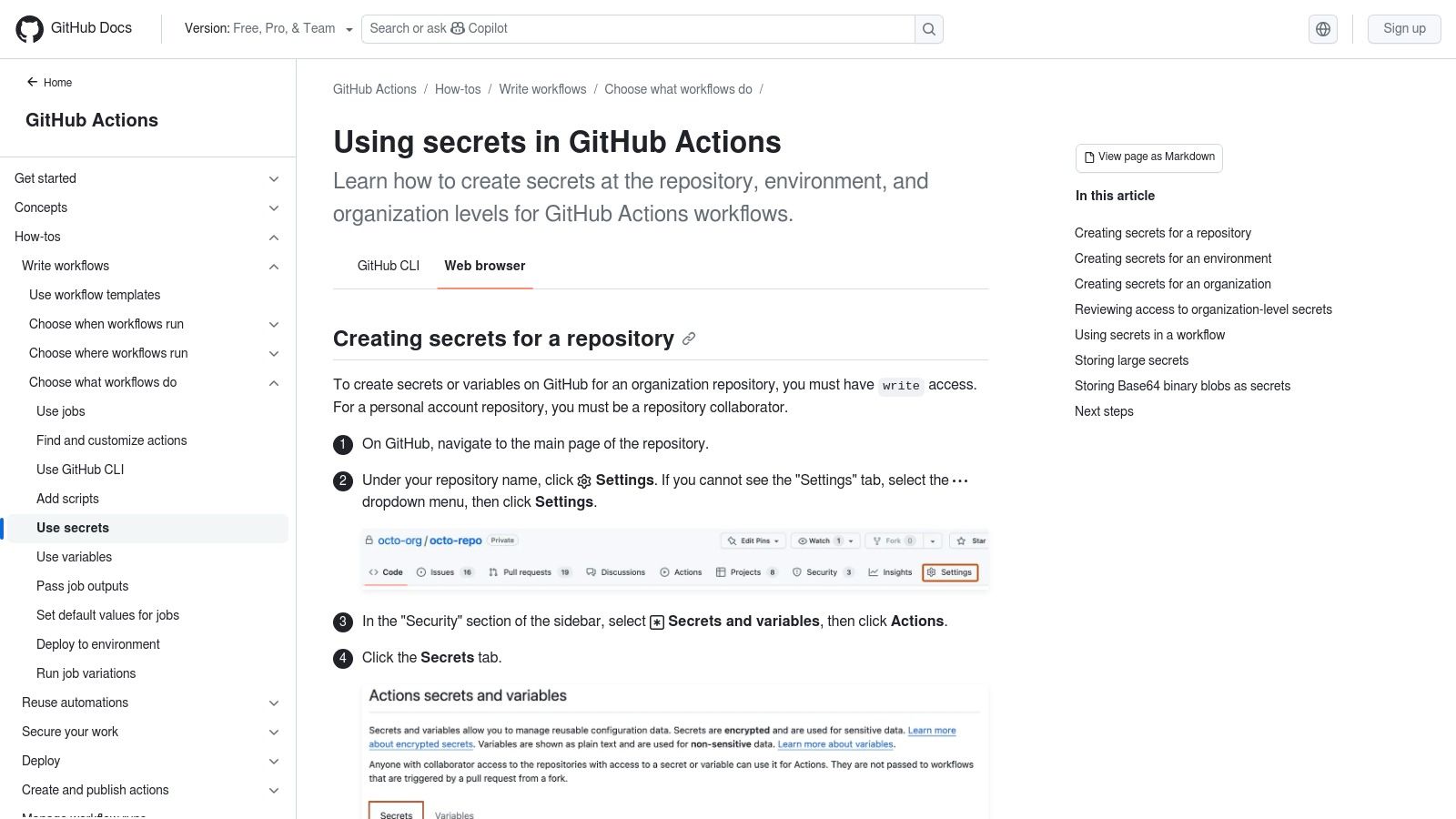
Key Considerations
- Deployment Models: This is a fully managed feature within GitHub.com (Cloud) and GitHub Enterprise Server. There is no self-hosting component outside of the GitHub platform itself, meaning operational overhead is zero.
- Pricing Structure: Secrets management is included with GitHub plans at no extra cost. Usage is tied to the limits of your GitHub Actions minutes and storage, but the secret store itself is a core, free feature.
- Use Cases: It is purpose-built for CI/CD workflows running on GitHub Actions. It is perfect for teams looking for a simple, integrated solution to inject credentials into build, test, and deployment jobs without adding a third-party tool. However, it is not a comprehensive, cross-platform enterprise secrets manager and lacks features like advanced auditing, secret rotation, or multi-cloud governance capabilities found in dedicated platforms.
Website: https://docs.github.com/en/actions/security-guides/using-secrets-in-github-actions
Top 12 Secrets Managers - Feature Comparison
| Solution | Deployment & Integration | Key Features | Best for | Pricing (notes) | Unique Strength |
|---|---|---|---|---|---|
| HashiCorp Vault | Self-managed or HCP; Terraform, Kubernetes, multi-cloud | Policy-driven secrets, dynamic secrets, PKI, namespaces, replication | Large enterprises; multi-cloud & regulated environments | HCP cluster + client charges; enterprise license | Mature ecosystem & extensibility |
| AWS Secrets Manager | Fully managed AWS; deep IAM & KMS integration | KMS encryption, automatic rotation, DR replication | AWS-centric workloads | Per-secret + per-API-call transparent pricing | Native AWS integration & regional coverage |
| Azure Key Vault | Managed Azure service; Azure AD/Entra integration | Secrets/keys/certs, HSM-backed SKUs, Azure Monitor logging | Microsoft-centric and hybrid AD estates | Transaction-based; tiered Standard/Premium SKUs | HSM/compliance & Azure AD RBAC |
| Google Cloud Secret Manager | Managed GCP; IAM & Pub/Sub rotation notifications | Per-version billing, rotation notifications, tight IAM | GCP-native developer teams | Simple per-version and access pricing; Always Free limits | Low-friction developer experience |
| CyberArk Secrets Manager | SaaS or self-hosted; enterprise integrations & Secrets Hub | Centralized non-human identities, audit trails, CI/CD support | Regulated enterprises at scale | Quote-based enterprise pricing | Strong compliance posture & PAM integration |
| Akeyless | SaaS or hybrid with on‑prem gateways | Zero-knowledge cryptography, KMS, multi-cloud connectors | Multi-cloud buyers seeking zero-knowledge security | Tiered by clients/connectors; often requires quote | Zero-knowledge design and fast deployment |
| Doppler | Hosted SaaS only; CLI/Kubernetes/CI integrations | Real-time sync, RBAC, SSO, activity logs, team workflows | Engineering teams focused on UX and velocity | Transparent per-seat pricing; free tier/trial | Developer-first UX and fast onboarding |
| Bitwarden Secrets Manager | Hosted; integrates with Bitwarden ecosystem | CLI/SDKs, machine accounts, granular permissions | Teams already using Bitwarden or cost-sensitive orgs | Competitive pricing; free tier available | Familiar ecosystem and cost-friendly option |
| 1Password (Secrets Automation) | Business-tier SaaS; optional self-hosted Connect | Service accounts, SDKs, K8s/Terraform/Ansible integrations | Organizations using 1Password for passwords & secrets | Included in business tiers; not priced per-secret | Consolidates password + secrets tooling |
| Keeper Secrets Manager (KSM) | Add-on to Keeper Business/Enterprise; SaaS | API/SDK retrieval, rotation, CI/CD integrations, PAM | Keeper customers and compliance-focused orgs | Quote-based; add-on licensing | Integrated PAM ecosystem & certifications |
| Infisical | Open-source core; cloud SaaS & self-hosted options | Dashboards, CLI/SDKs, rotation, K8s operator, secret scanning | Dev teams wanting OSS flexibility and transparency | Transparent plans with free tier | Open-source + transparent pricing |
| GitHub Actions Secrets | Built into GitHub; repo/env/org scope | Scoped secrets, OIDC federation, Actions integration | CI/CD workflows hosted in GitHub Actions | No extra cost beyond GitHub plan | Immediate, simple fit for Actions workflows |
Securing Your Foundation for the Future
Choosing the right secrets management tool is far more than a simple procurement decision; it's a strategic investment in your organization's security posture and a critical enabler of modern development velocity. As we've explored, the landscape of the best secrets management tools is diverse, with solutions tailored to virtually every scale, tech stack, and operational model. Moving beyond static .env files or insecure shared documents is no longer optional in an environment where a single leaked credential can lead to a catastrophic breach.
The journey to secure, dynamic, and automated secrets management requires careful consideration of where your organization is today and where it plans to be tomorrow. The tools we've detailed fall into several broad categories, each with its own distinct advantages and trade-offs.
Key Takeaways and Decision-Making Framework
To navigate this complex decision, reflect on the core themes we've discussed:
- Operational Overhead vs. Control: Solutions like HashiCorp Vault offer unparalleled flexibility and control but demand significant operational expertise to manage and scale. In contrast, cloud-native services like AWS Secrets Manager, Azure Key Vault, and Google Cloud Secret Manager offload this burden, providing seamless integration within their respective ecosystems at the cost of some vendor lock-in.
- Developer Experience is Paramount: Developer-first tools such as Doppler, Infisical, and Bitwarden Secrets Manager have fundamentally shifted the focus to user experience. By simplifying the injection of secrets into local development environments, CI/CD pipelines, and production workloads, they reduce friction and encourage adoption, which is often the biggest hurdle to a successful implementation.
- The Zero-Trust Imperative: The ultimate goal is to move towards a zero-trust architecture where trust is never assumed and access is granted on a temporary, just-in-time basis. Tools that support dynamic secrets, short-lived credentials, and tight integration with Identity and Access Management (IAM) systems are foundational to achieving this modern security paradigm.
- Integration is Everything: A tool's true power is realized through its ecosystem. Assess how well a potential solution integrates with your existing infrastructure-as-code (Terraform, Pulumi), container orchestration (Kubernetes, ECS), CI/CD platforms (GitHub Actions, Jenkins), and application frameworks. A lack of native, well-documented integrations can quickly turn an ideal solution into a source of technical debt.
Your Actionable Next Steps
Before you commit to a platform, use the comparison matrix and detailed reviews in this article as a guide. Start by creating a shortlist based on your specific requirements:
- Define Your Threat Model: What are you protecting, and from whom? Your compliance needs (SOC 2, HIPAA, GDPR) will immediately narrow the field. For a comprehensive understanding of broader security strategies, this ultimate guide to cyber security provides essential insights for companies.
- Evaluate Your Team's Capacity: Be realistic about your team's ability to manage a self-hosted solution. If you lack dedicated DevOps or security engineering resources, a managed service is almost always the more prudent choice.
- Run a Proof of Concept (POC): Select your top two or three candidates and run a small-scale POC. Integrate them with a non-critical application and have a small group of developers use them. This real-world test will reveal usability issues and integration challenges far more effectively than any feature list.
Ultimately, selecting one of the best secrets management tools is a foundational step in building a resilient, secure, and efficient engineering organization. By centralizing, automating, and auditing access to your most sensitive credentials, you empower your teams to build and innovate with confidence, knowing their applications and infrastructure are built on a secure foundation for the future.
Feeling overwhelmed by the options or need expert guidance to implement a secrets management solution that aligns with your specific cloud architecture and DevOps workflows? The team at Pratt Solutions specializes in cloud security, infrastructure automation, and helping organizations navigate these critical decisions. Reach out to Pratt Solutions for a consultation to accelerate your journey to a more secure and automated future.