Mastering Your Move With Cloud Migration Consulting
#cloud-migration-consulting#cloud-strategy#IT-consulting#digital-transformation#cloud-services
December 2, 2025
So, what exactly is cloud migration consulting? Think of it as hiring a team of seasoned architects and engineers to help you move your company's digital operations - your data, applications, and infrastructure - from your own servers to a cloud platform.
These consultants are more than just tech support; they're strategic partners. Their job is to make sure your move to the cloud is secure, stays on budget, and actually helps you achieve your business goals. They're there to help you sidestep common disasters like runaway costs and operational chaos.
Why Smart Businesses Use Cloud Migration Consulting
Moving to the cloud isn't just a technical swap-out. It's a fundamental shift in how your business runs. Going it alone is like trying to build a custom house without an architect - you might have a general idea of what you want, but you lack the blueprints and engineering know-how to build a solid foundation.
A cloud migration consultant is that architect. They take your big-picture ambitions - like being more agile, outpacing competitors, or future-proofing your operations - and translate them into a concrete, step-by-step technical plan.
Turning Ambition into Action
At its core, consulting is all about reducing the risk of a very complex and expensive project. Consultants have seen it all before, having worked on hundreds of similar migrations. This experience allows them to spot potential roadblocks your team might miss, from hidden application dependencies to tricky security protocols and, of course, realistic cost projections.
Their expertise helps businesses avoid the all-too-common migration failures and see real results much faster. This is exactly why the demand for expert help is through the roof. The global cloud migration consulting market is expected to hit roughly $75 billion by 2025, a number that shows just how critical professional guidance has become. You can dig into the drivers behind this growth in this comprehensive report.
This isn't just about moving data from point A to point B. It's about redesigning your business to be more efficient, resilient, and ready for whatever comes next.
The Strategic Business Drivers
Companies don't hire cloud migration consultants just for the tech. They do it to solve specific, high-stakes business problems. The real motivators are almost always strategic and financial.
Here are the top reasons businesses bring in the experts:
- Cost Optimization and Control: Consultants are masters at finding ways to cut operational spending by "right-sizing" resources and killing off the need for massive upfront hardware purchases. They put FinOps practices in place to help you avoid the dreaded "bill shock" that can follow a messy migration. To dig deeper, check out our guide on proven IT cost reduction strategies.
- Enhanced Security and Compliance: Trying to navigate the maze of data protection laws like GDPR or HIPAA in a brand-new cloud environment is a nightmare. Consultants build security into the architecture from day one, ensuring your data is locked down and compliant from the get-go.
- Accelerated Innovation: By handing off the burden of infrastructure management, your internal teams are freed up to do what they're paid for: building great products and delighting customers. A good consultant ensures the cloud platform they build is a stable, scalable launchpad for innovation.
The table below shows how consultants connect high-level business goals with tangible cloud-driven results.
How Consultants Translate Business Goals into Cloud Outcomes
| Business Driver | Consulting Value | Expected Business Outcome |
|---|---|---|
| Reduce Operational Costs | FinOps implementation, rightsizing analysis, and managed services | 20-30% reduction in IT overhead; shift from CapEx to OpEx |
| Increase Business Agility | DevOps and CI/CD pipeline implementation; serverless architecture design | Faster time-to-market for new features; ability to scale on demand |
| Strengthen Security Posture | Cloud-native security architecture design; automated compliance checks | Reduced risk of data breaches; continuous compliance with regulations |
| Improve Disaster Recovery | Multi-region deployment strategy; automated failover and backup | Near-zero downtime; improved business continuity and resilience |
By aligning every technical decision with a business objective, consultants ensure the project isn't just a technical exercise but a powerful driver of business value.
By framing the migration around business outcomes, consultants ensure the project delivers measurable value. The goal is never just to 'get to the cloud' - it's to build a better, more competitive business once you're there.
The Four Phases of a Successful Migration Journey
Think of a cloud migration like building a custom home. You wouldn't just start digging without a detailed blueprint, and you definitely shouldn't move your company's critical systems to the cloud without a solid, phased plan. A good consultant acts as your architect and general contractor, guiding you through four distinct phases to turn a potentially chaotic project into a predictable journey.
This structured approach is non-negotiable in today's complex IT world. The demand for cloud migration expertise is surging for a reason. The market is projected to leap from $54.47 billion in 2025 to a staggering $159.41 billion by 2032. Migration and deployment services alone account for over 23% of that spend, which tells you just how much value businesses place on getting this right the first time. You can dig into the numbers in this market analysis on cloud services.
Let's break down what that expert-led journey actually looks like.
Phase 1: Discovery and Assessment
This is the "home inspection" phase. Before you can plan the move, you need to know exactly what you have. Consultants roll up their sleeves and act like digital detectives, mapping out your entire IT landscape. This isn't just about making a list of servers; it's a deep-dive analysis of every application, database, and network dependency.
The real goal here is to uncover the hidden "gotchas" that could derail the project. For example, they might find a 15-year-old accounting app that no one realized was quietly feeding data to a dozen other critical systems. Trying to move that app in isolation would be a recipe for disaster.
Key activities include:
- Application Portfolio Analysis: Figuring out what every application does, who uses it, how important it is, and how difficult it will be to move.
- Infrastructure Mapping: Getting a complete picture of your servers, storage, and network setup as it exists today.
- Dependency Discovery: Using specialized tools to untangle the web of connections between your applications and infrastructure. It's about finding out what talks to what.
This phase wraps up with a detailed report that becomes the foundation for everything that follows. It gives everyone a clear, honest starting point and flags the biggest risks upfront.
Phase 2: Strategy and Planning
With a complete map of your current environment in hand, it's time to draw the blueprint for your future one. This is where high-level business goals get translated into a concrete technical strategy. Your consultant will work closely with your team to define what "success" actually means for you and how the cloud can get you there.
This is also where the numbers get real. A crucial part of this phase is building a Total Cost of Ownership (TCO) model. This isn't a back-of-the-napkin calculation; it's a detailed comparison of your current IT spend versus the projected costs in the cloud, ensuring the move makes financial sense.
A well-defined plan is the single greatest predictor of migration success. It aligns technical teams and business leaders around a common set of goals, a realistic timeline, and a clear budget, preventing costly surprises down the line.
The planning phase produces the most important documents of the entire project:
- A detailed migration roadmap that outlines which applications move when and how they'll be moved.
- The selection of the right cloud provider and architecture (e.g., AWS vs. Azure, using containers vs. going serverless).
- A comprehensive project plan with clear milestones, timelines, and who is responsible for what.
Phase 3: Execution and Migration
Welcome to moving day. This is where the plan is put into action and the technical heavy lifting begins. The consulting team starts migrating your applications, data, and workloads to their new home in the cloud. This process is handled with surgical precision to minimize - or completely avoid - disruption to your day-to-day business.
Nobody moves everything at once. Migrations are almost always done in waves, starting with less critical applications to work out the kinks and build momentum. The consultant manages the entire process, from setting up the new cloud infrastructure to shifting the data and reconfiguring the apps. At every step, there's rigorous testing to make sure everything works perfectly before the final switch is flipped.
Phase 4: Optimization and Governance
Getting to the cloud isn't the finish line; it's the starting line. The final phase is all about making sure you thrive in your new environment for the long haul. Once the migration dust settles, the focus shifts to fine-tuning performance, locking down costs, and establishing smart rules for managing it all.
Consultants will help you "right-size" your cloud resources, ensuring you aren't paying for more capacity than you need. They'll also help implement robust security policies, set up proper monitoring, and automate routine tasks. Most importantly, they'll train your team and hand over the keys, making sure you have the skills and documentation to manage your new cloud environment with confidence. This is what turns a one-off project into a sustainable competitive advantage.
The 7 Rs: Picking Your Path to the Cloud
So, you've decided to move to the cloud. The big question is: how? This isn't just about packing up your digital assets and shipping them off. It's more like moving into a new house - you have choices. Do you just move all your old furniture as-is? Or do you take the opportunity to declutter, renovate, and buy new things that fit the space better?
In cloud migration, these choices are known as the "7 Rs". They represent a spectrum of strategies, from a simple "lift-and-shift" to a complete application overhaul. A good consultant doesn't just pick one; they help you choose the right "R" for each specific application, perfectly balancing your need for speed with your long-term goals.
The entire consulting process is built around making these strategic decisions correctly. It's a structured journey from discovery to optimization, ensuring that the migration path you choose is the right one from day one.
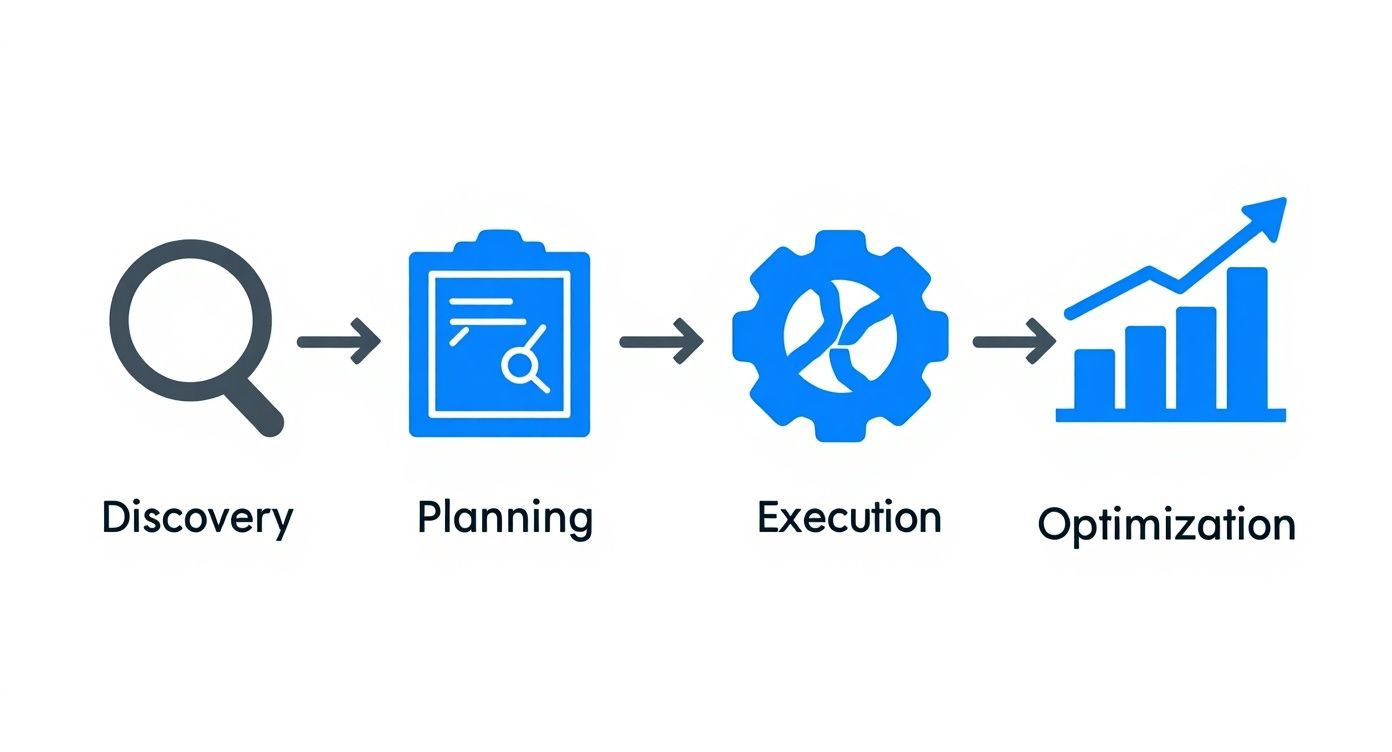
As you can see, choosing a strategy isn't a shot in the dark. It's a direct result of careful discovery and planning, making sure every move is deliberate and adds value.
Comparing the 7 Rs of Cloud Migration
Think of these strategies as a toolkit. Some are quick and straightforward, while others require more effort but deliver bigger rewards. The table below breaks down the seven common migration patterns, giving you a clear look at the effort, cost, and best-fit scenarios for each one. This is the exact framework a consultant will use to analyze your application portfolio.
| Strategy (The 'R') | Description | Effort & Cost | Best For |
|---|---|---|---|
| Rehost | "Lift-and-Shift." Moving an application to the cloud with minimal or no changes. | Low | Large-scale migrations where speed is critical; applications you can't or don't want to modify. |
| Replatform | "Lift-and-Tinker." Making a few cloud optimizations without changing the core architecture. | Low to Medium | Gaining quick wins like improved performance or cost by switching to managed databases or auto-scaling. |
| Repurchase | "Drop-and-Shop." Moving from a legacy application to a modern SaaS product (e.g., old CRM to Salesforce). | Variable | Getting out of managing legacy software; applications where a commercial off-the-shelf solution is a better fit. |
| Refactor | Re-architecting an application, often using cloud-native features like microservices or serverless. | High | Core business applications that need high scalability, new features, and better performance. |
| Retire | Decommissioning applications that are no longer needed. | Very Low | Redundant or obsolete applications discovered during the portfolio analysis. |
| Retain | Keeping an application on-premises or in its current environment, at least for now. | Very Low | Applications with regulatory constraints, complex dependencies, or systems that aren't a priority for migration. |
| Relocate | Moving infrastructure to the cloud without purchasing new hardware, changing operations, or rewriting apps. | Low | Moving a large number of servers quickly, often used for VMware-based workloads moving to services like VMware Cloud on AWS. |
Ultimately, a successful cloud journey rarely relies on a single strategy. Most organizations end up with a mix-and-match approach - rehosting dozens of simple apps, refactoring a critical few, and retiring the ones that have been collecting dust.
From Simple Moves to Full Renovations
Not every application is a candidate for a full-blown renovation. Some are perfectly fine and just need a new place to run. A consultant's first job is to help you sort your applications into different buckets based on their business value and technical complexity.
"The goal isn't just to run on new servers. It's to build a more resilient, scalable, and cost-effective business. Choosing the right migration strategy for each application is how you get there."
Here's a practical way to think about the most common approaches:
- Rehost (The Quick Move): This is the fastest way to get to the cloud. You're essentially copying and pasting your servers from your data center to a cloud provider like Amazon Web Services (AWS) or Microsoft Azure. It's not fancy, but it gets the job done when you need to exit a data center fast.
- Replatform (The Smart Tweak): Here, you make a few small but impactful changes. For example, instead of managing your own database server on a virtual machine, you move your data to a managed service like Amazon RDS. You've barely touched the application, but you've already offloaded a ton of operational work.
- Repurchase (The Modern Upgrade): Why move your clunky, ten-year-old accounting software? Just get rid of it and switch to a modern, cloud-based solution. This "drop-and-shop" approach means moving your data and processes to a Software-as-a-Service (SaaS) platform, freeing you from managing the underlying application entirely.
Advanced Strategies for What Matters Most
For the applications that truly run your business, a simple move just won't cut it. These core systems are where you have the biggest opportunity to gain a competitive edge. This is where you stop thinking like a mover and start thinking like an architect.
- Refactor/Rearchitect (The Full Remodel): This is the most intensive strategy, but it also delivers the biggest payoff. You're fundamentally rebuilding parts of your application to take full advantage of cloud-native services. Think breaking a massive application into nimble microservices or going serverless. It's a big project, but the result is an application that's incredibly scalable, resilient, and cheaper to run.
- Retire (The Declutter): Every organization has them - applications running on a forgotten server in the corner that nobody has touched in years. The discovery phase is your chance to identify this digital clutter. Retiring these applications is an easy win that immediately saves money and reduces your security risks.
- Retain (The "Wait and See"): Sometimes, the best move is no move at all. You might have a highly specialized system that can't run in the cloud or an application tied to strict data residency rules. The "Retain" strategy is a conscious decision to leave certain workloads on-premises for now, with a plan to re-evaluate them in the future.
A cloud migration consultant uses discovery tools to map out all your applications and their dependencies, creating a visual guide that makes it clear which strategy fits where. This data-driven approach removes the guesswork and ensures your migration plan is built on a solid foundation of facts, not assumptions.
Managing Cloud Security and Controlling Costs

Even the most promising cloud projects can get derailed by two major hurdles: glaring security holes and budgets that spiral out of control. Moving to the cloud is so much more than a server swap; it's a complete shift in how you handle security and financial governance. This is where an experienced consultant becomes invaluable, helping you navigate these critical areas right from the start.
Getting this balance right ensures your new cloud environment isn't just powerful but also secure and financially sustainable for the long haul.
Understanding the Shared Responsibility Model
One of the biggest - and most dangerous - misconceptions about the cloud is that the provider handles all the security. It doesn't work that way. In reality, security is a partnership governed by the Shared Responsibility Model.
Think of it like this: your cloud provider is the landlord of a high-security apartment building. They are responsible for securing the physical building, the gates, and the lobby. But you are still responsible for locking your own apartment door and deciding who gets a key. In the cloud, your data, applications, and access controls are your responsibility.
A good consultant's first job is to draw a clear line in the sand, showing you exactly where the provider's responsibility ends and yours begins. This line shifts depending on the services you use, and getting it wrong can leave you wide open to attack.
They'll help you build robust defenses on your side of the line, including:
- Data Encryption: Making sure your data is scrambled and unreadable, both when it's moving across the network (in transit) and when it's sitting on a server (at rest).
- Identity and Access Management (IAM): Implementing a "least privilege" policy, ensuring people can only access the specific resources they absolutely need to do their jobs.
- Compliance Adherence: Configuring your environment to meet tough industry regulations like HIPAA or GDPR. For many businesses, this isn't optional - it's a requirement.
Preventing Bill Shock with FinOps
The cloud's pay-as-you-go model is a double-edged sword. While the flexibility is fantastic, it can also lead to "bill shock" - that heart-stopping moment you see an invoice that's way higher than you expected. This is where consultants bring in the discipline of FinOps, or Financial Operations.
FinOps isn't just a tool; it's a cultural shift that brings financial accountability to the cloud's variable spending model. It's all about making smart, data-driven decisions on where your money is going in near real-time. Before diving in, grasping the fundamentals of cloud cost optimization is a great first step.
FinOps isn't just about saving money; it's about making money. By optimizing cloud spend, you free up capital to reinvest in innovation and growth, maximizing the ROI of your migration.
Consultants use a few proven tactics to get your costs under control:
- Right-Sizing Resources: They'll dig into your actual usage data to spot oversized virtual machines or storage you're paying for but not using. It's amazing how much waste this uncovers.
- Leveraging Cost-Saving Plans: They'll guide you toward pricing models like Reserved Instances or Savings Plans. Committing to usage upfront can slash your bills by up to 70% compared to standard on-demand rates.
- Implementing Monitoring and Alerts: They set up dashboards and automated alerts to flag you when spending starts creeping past your budget, so there are no ugly surprises at the end of the month.
By embedding these financial practices into your daily operations, a consultant ensures your cloud investment delivers predictable, sustainable value. Of course, properly choosing a cloud provider with transparent pricing and solid cost management tools is a foundational piece of this strategy.
How to Choose the Right Consulting Partner
Picking a partner for your cloud migration is, without a doubt, the single most important decision you'll make in this entire journey. This isn't just about hiring a few technical whizzes. You're looking for a strategic partner who gets your business, buys into your vision, and has a proven playbook for navigating these kinds of complex projects. A great consultant becomes an extension of your own team, not just another vendor on the payroll.
The stakes are incredibly high, and the market for these services is exploding. The global cloud migration services market is on track to hit $300 billion in 2025 and is projected to soar to an unbelievable $1.03 trillion by 2030. With large enterprises making up over 62% of that spend, it's clear that expert guidance is non-negotiable for big, complex moves. You can dig into the numbers yourself in this detailed industry report on cloud migration services.
All this growth means you have more choices than ever, which makes having a solid framework for vetting potential partners absolutely essential.
Look for Proven Expertise and Certifications
Technical skill is just the price of entry. Any consultant worth their salt will have deep experience, but you need to see objective proof of that expertise. This is where official certifications from the major cloud providers become a critical signal of quality.
Think of these as more than just badges. They represent a serious investment in training, a documented history of successful projects, and a tough vetting process by the cloud providers themselves.
- AWS Premier Tier Services Partner: This is the highest honor in the AWS Partner Network. It's reserved for firms with extensive experience and a deep bench of certified pros who have consistently delivered for customers.
- Azure Expert Managed Service Provider (MSP): This elite status is given to Microsoft Azure partners who pass a demanding third-party audit of their technical skills and customer service chops.
- Google Cloud Premier Partner: This title signifies the highest level of expertise in helping businesses get the most out of Google Cloud solutions.
For example, being an AWS Premier Tier partner means a firm has met incredibly strict requirements for both technical knowledge and customer success.
This screenshot highlights the top-tier partners that AWS recognizes. Choosing from this list means you're working with a company that AWS itself has put its stamp of approval on.
Evaluate Their Migration Methodology
A top-tier consultant doesn't just show up and start moving things. They operate with a well-defined, repeatable methodology that brings structure to the potential chaos of a large-scale migration. When you're talking to them, ask them to walk you through their process, from the initial discovery and assessment all the way to post-migration optimization.
A proven methodology is your best insurance against project delays and budget overruns. It demonstrates that the consultant has a structured, predictable approach for managing risk, communicating progress, and delivering results.
Their framework should clearly lay out the four key phases we've discussed: assessment, planning, migration, and optimization. If they can't articulate a clear, phased approach, that's a major red flag. They should also be ready to show you how their methodology played out in the real world, which you can compare with these cloud migration success stories.
Ask the Right Questions
The interview process is your chance to get past the slick sales pitch. You need to ask tough, specific questions that reveal how they really think, solve problems, and work with their clients.
Here are a few essential questions to ask any potential cloud migration consulting partner:
- Beyond the Migration: "How will you enable our internal team to manage the new cloud environment effectively after you're gone?" This tests their commitment to your long-term independence, not just checking a box on a project plan.
- Problem-Solving Skills: "Describe a time a migration hit an unexpected technical snag. What was it, and how did your team work through it?" This gives you a window into their real-world troubleshooting abilities.
- Industry Experience: "What experience do you have in our industry? Can you show us case studies of companies like ours that you've helped?" Niche expertise in areas like finance or healthcare can be invaluable.
- Cost Management Approach: "How do you maintain cost transparency and help clients avoid 'bill shock' after they go live?" This shows you whether they truly understand FinOps and financial governance.
The answers you get will help you separate the true strategic partners from the mere vendors, ensuring you pick a firm that will guide you to a successful and sustainable future in the cloud.
Your Cloud Migration Readiness Checklist
Before you even think about picking up the phone to call a cloud consultant, a little internal homework can make a world of difference. Doing a quick self-assessment doesn't just save you time and money down the road; it puts you firmly in the driver's seat of your own cloud journey.
When you've done your prep work, you can give a consultant the right context to build a sharp proposal and a timeline that actually makes sense. Answering these questions first helps you get your own team on the same page about what you're trying to achieve.
Business and Financial Alignment
Let's get one thing straight: the most important part of any migration is tying it to real business outcomes, not just chasing new tech. You have to know what "success" looks like in dollars and sense, and you absolutely need your leadership team bought in from day one.
- Define Success: What specific business number will this move? Are you trying to slash operational costs by 15%? Cut the time it takes to launch new features? Guarantee better uptime for your customers? Get specific.
- Identify Stakeholders: Who really needs to be in the room for this? Think beyond IT - which business leaders and department heads will be affected and need to have a say?
- Establish a Budget: What's the ballpark budget you have in mind? This needs to cover not just the consultant's fees but also what you'll be spending with AWS, Azure, or Google Cloud each month.
A migration without clear business goals is just a costly science experiment. Knowing your 'why' is the single most important factor in achieving a positive return on investment.
Technical and Infrastructure Inventory
You can't plan a trip without knowing your starting point. While any good consultant will do a deep-dive discovery, having a basic map of your current IT world will speed things up immensely. You just need a high-level picture of what you have and how it all talks to each other.
- Application Portfolio: Which apps are the lifeblood of your business? On the flip side, which ones are ancient, tangled, or have a web of dependencies you're scared to touch?
- Data and Dependencies: Where is your crown-jewel data stored? Do you have a clear picture of which apps and services depend on each other to work?
- Current Infrastructure: What's the general health of your servers and data centers? Are any big hardware refresh cycles or expensive hosting contracts coming up for renewal soon?
People, Culture, and Governance
A move to the cloud isn't just a technical shift; it changes how your team works every single day and demands new skills. It's also critical to know your non-negotiable security and compliance rules from the start to avoid hitting a brick wall later.
- Team Skills: Does your team already have some cloud pros, or are you looking at a major training effort to get everyone up to speed after the move?
- Cultural Readiness: Is your organization ready to embrace a more agile, DevOps way of thinking and working? This can be a huge cultural shift.
- Security and Compliance: What are your must-have security standards and regulatory burdens? Think GDPR, HIPAA, or any other industry-specific rules you live by.
To help you get a running start, it's worth walking through a detailed cloud migration assessment checklist. Thinking through these points internally ensures that when you do talk to a potential partner, you're doing it from a position of clarity and strength.
Got Questions? We've Got Answers
Even with the best roadmap, you're bound to have questions. Moving to the cloud is a big deal, after all. Here are a few of the most common things we hear from business leaders who are weighing their options.
How Long Is This Actually Going to Take?
That's the million-dollar question, and the honest answer is: it depends. If you're doing a simple “lift-and-shift” of a handful of basic apps, you might be looking at a few weeks. But for a large company with older, complex systems that need to be rebuilt for the cloud, you could be looking at a project that spans six months to well over a year.
This is where a good consultant really proves their worth. They don't just give you a guess; they perform a deep-dive assessment of your current setup to give you a realistic timeline. That way, you can plan around the project without any nasty surprises.
What Kind of Paperwork and Plans Should I Expect?
A professional engagement isn't just about doing the work; it's about documenting it so you're in control long after the project is done. While the exact documents can vary, there are a few non-negotiables you should always get.
You should walk away with:
- A Detailed Assessment Report that maps out your current IT world.
- A formal Migration Strategy and Roadmap - your step-by-step guide.
- A transparent Total Cost of Ownership (TCO) Analysis.
- A comprehensive Project Plan with clear dates and deliverables.
- After you go live, you'll need all the Configuration Documentation, a final security report, and a Cost Optimization Plan to manage your spending.
How Exactly Do Consultants Save Us Money?
Cutting costs is a huge driver for cloud migration, but savings aren't automatic. In fact, it's surprisingly easy to overspend without a solid plan. A consultant's job is to build a financial strategy right into your migration from day one.
Consultants turn the cloud from a potential budget black hole into a predictable, optimized operating expense. They do this by embedding financial discipline - a practice known as FinOps - directly into your cloud architecture and operational culture.
They achieve this by "right-sizing" your services so you're not paying for power you don't need, locking in discounts of up to 70% with smart pricing models like Reserved Instances, and setting up automated alerts to catch budget creep before it happens.
What Happens After We've Migrated?
The job isn't done just because the last server has been moved. The best consulting partnerships transition from migration to optimization, ensuring you're set up for long-term success.
In this final phase, your consultant will fine-tune performance in the new environment, help you establish solid governance policies, and train your team. The goal is to hand over the keys with the knowledge your team needs to confidently run the show on their own.
At Pratt Solutions, we specialize in turning complex cloud ambitions into reality. We deliver custom, secure, and scalable cloud solutions that drive measurable business results. Let's build your cloud future together.