Top 12 Serverless Framework Alternatives for Cloud Teams in 2026
#serverless#cloudcomputing#devops#serverlessarchitecture#cloudnative
Explore 12 top Serverless Framework alternatives. Our guide covers AWS SAM, CDK, Pulumi, and more to help you choose the right tool for your next project.


The Serverless Framework has long been a go-to for deploying cloud applications, but the landscape is evolving. As teams seek better developer experiences, multi-cloud support, and deeper integration with their preferred languages, a new generation of powerful serverless framework alternatives has emerged. This shift is part of a larger trend where businesses are looking to maximize the benefits of cloud computing by adopting tools that offer greater flexibility and operational efficiency.
Whether you're hitting the limits of your current setup, building a new cloud-native application, or simply evaluating the best tools for the future, understanding these alternatives is critical. This guide provides a detailed, actionable breakdown of 12 leading options, moving beyond marketing claims to offer practical insights on use cases, limitations, and real-world implementation. Each entry includes direct links and analysis to help you make a fully informed decision.
We'll help you navigate the choices, from first-party AWS tools like SAM and CDK to multi-cloud Infrastructure as Code (IaC) powerhouses like Pulumi and Terraform. You'll also discover specialized frameworks like SST for full-stack applications and language-specific tools like Chalice and Bref. Our goal is to equip your team with the knowledge to select a framework that aligns perfectly with your existing skills, CI/CD pipeline, and long-term project goals. This resource is designed to be your definitive guide for finding the right deployment tool, fast.
1. AWS Serverless Application Model (AWS SAM)
As a direct competitor and one of the most popular serverless framework alternatives, the AWS Serverless Application Model (SAM) is an open-source framework developed and maintained by AWS itself. It provides a streamlined way to define serverless applications using a concise YAML or JSON syntax, which is an abstraction layer built on top of AWS CloudFormation. This first-party origin is its key differentiator, ensuring day-one support for new AWS services and features.

The framework is centered around the SAM Command Line Interface (CLI), a powerful tool that enables local building, testing, and debugging of Lambda functions in a Docker container that simulates the live AWS environment. This local development loop, enhanced by features like sam sync, significantly accelerates development cycles before deploying to the cloud. Teams already invested in the AWS ecosystem or those prioritizing deep integration with CloudFormation will find SAM a natural fit.
Key Details & Use Cases
- Primary Use Case: Best for teams fully committed to the AWS ecosystem who want an official, CloudFormation-compatible tool for building event-driven applications, APIs, and data processing pipelines. It's ideal for projects that require tight integration with other AWS services like API Gateway, DynamoDB, and S3.
- Pricing: The framework is completely open-source and free. You only pay for the underlying AWS resources your application consumes.
- Maturity & Support: Being an official AWS tool, it has a mature ecosystem, extensive documentation, and direct support channels. The SAM CLI includes built-in commands like
sam pipeline initto bootstrap CI/CD pipelines for popular systems like AWS CodePipeline, Jenkins, and GitLab.
Our Take: While it locks you into the AWS ecosystem, SAM offers an unparalleled developer experience for building on AWS. The tight integration and local testing capabilities are significant advantages that showcase the benefits of serverless architecture when implemented with native tooling.
Website: https://aws.amazon.com/serverless/sam/
2. AWS Cloud Development Kit (AWS CDK)
For teams that prefer imperative programming over declarative templates, the AWS Cloud Development Kit (CDK) is a powerful serverless framework alternative. This open-source framework from AWS allows you to define your cloud infrastructure using familiar programming languages like TypeScript, Python, Java, and C#. The CDK code is then synthesized into standard AWS CloudFormation templates for reliable and repeatable deployments. This code-first approach enables developers to leverage the full power of their chosen language, including logic, loops, and object-oriented principles, to create reusable infrastructure components.

The core strength of the CDK lies in its high-level constructs, which provide sensible defaults and best practices for AWS resources, significantly reducing the amount of boilerplate code required. Instead of defining every single property for a VPC or a Lambda function, developers can use these well-architected patterns to provision complex infrastructure with just a few lines of code. This abstraction accelerates development and allows teams to build their own libraries of custom, company-specific infrastructure patterns, promoting consistency and reusability across projects.
Key Details & Use Cases
- Primary Use Case: Best suited for development teams who want to manage Infrastructure as Code (IaC) using general-purpose programming languages. It excels in complex environments where creating reusable, high-level abstractions and patterns can drastically improve productivity and maintainability for serverless and containerized applications.
- Pricing: The AWS CDK framework itself is open-source and free to use. You are only billed for the AWS resources that your CDK application creates and manages.
- Maturity & Support: As an official AWS project, the CDK is mature, well-documented, and boasts a rapidly growing community. The AWS Construct Hub provides a central repository for discovering and sharing open-source CDK constructs, further extending its capabilities.
Our Take: The CDK represents a paradigm shift for IaC on AWS, empowering developers to build cloud infrastructure with the same tools they use for application code. While it introduces a learning curve, the payoff in terms of abstraction and reusability is immense, especially when integrated into modern CI/CD pipeline best practices.
Website: https://aws.amazon.com/cdk/
3. Pulumi
Pulumi stands out among serverless framework alternatives by shifting from YAML or JSON configurations to a true code-first approach. It's an open-source, multi-cloud Infrastructure as Code (IaC) platform that allows developers to define and deploy serverless applications on AWS, Azure, and GCP using familiar programming languages like TypeScript, Python, Go, and C#. This empowers teams to leverage existing language features like loops, functions, and classes to create reusable and dynamic infrastructure.

The platform consists of an open-source CLI for local development and deployment, alongside an optional managed service called Pulumi Cloud. Pulumi Cloud handles state management, secrets encryption, and provides collaboration features and policy-as-code enforcement. This flexibility allows teams to start with a self-managed backend (like an S3 bucket) and graduate to the managed service as their needs for governance and team collaboration grow, making it a highly adaptable choice.
Key Details & Use Cases
- Primary Use Case: Ideal for development teams who want to manage infrastructure using the same programming languages they use for application code. It excels in complex, multi-cloud, or hybrid cloud environments where a single tool is needed to provision both serverless functions and traditional resources like Kubernetes clusters or databases.
- Pricing: The Pulumi CLI is open-source and free. The optional Pulumi Cloud has a free tier for individuals, with paid plans for teams that add features like SAML/SSO, role-based access control, and advanced policy enforcement.
- Maturity & Support: Pulumi is a mature platform with a strong community, extensive documentation, and a large library of pre-built components. It integrates seamlessly with all major CI/CD providers, simplifying automated testing and deployment workflows across different cloud environments.
Our Take: For teams where developers manage infrastructure, Pulumi is a game-changer. Using a real programming language instead of a DSL reduces the learning curve and unlocks powerful abstractions, making it an excellent option for managing sophisticated serverless architectures across one or more clouds.
Website: https://www.pulumi.com/
4. HashiCorp Terraform / HCP Terraform (Cloud)
While not a serverless-specific tool, HashiCorp Terraform has become one of the most prominent serverless framework alternatives due to its dominance in the Infrastructure as Code (IaC) space. It uses a declarative configuration language (HCL) to define and provision infrastructure across any cloud provider. This vendor-agnostic approach is its greatest strength, allowing teams to manage serverless functions, API gateways, and databases alongside their traditional infrastructure using a single, unified workflow.
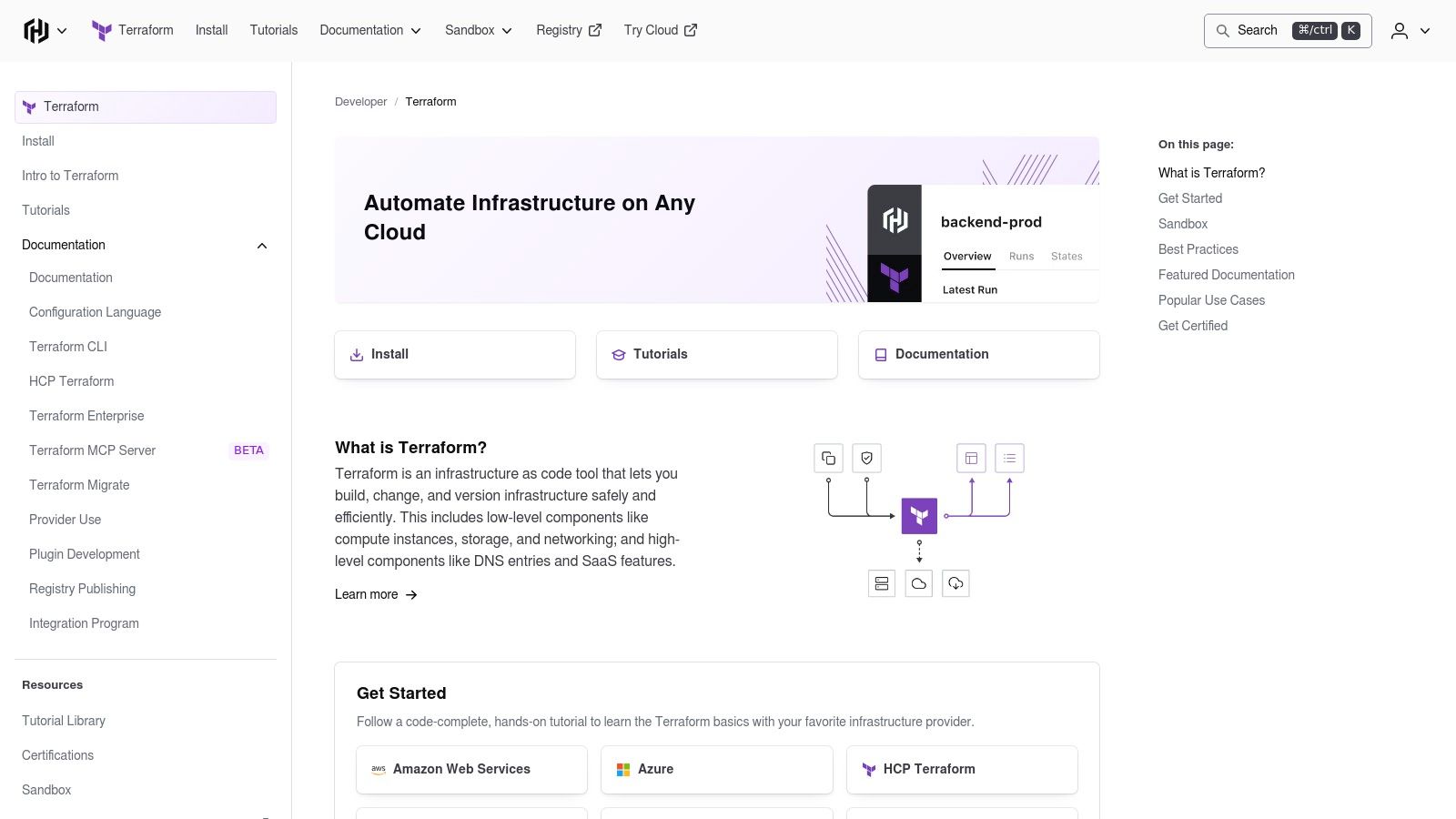
Terraform manages infrastructure state, providing a clear plan of changes before applying them, which brings predictability and auditability to deployments. While the open-source CLI manages state locally, HCP Terraform (Terraform Cloud) adds collaborative features like remote state management, run triggers, and policy as code. Its massive provider ecosystem and public module registry mean pre-built configurations for common serverless patterns are readily available, significantly reducing boilerplate code.
Key Details & Use Cases
- Primary Use Case: Best for organizations that have already standardized on Terraform for IaC and want to extend that workflow to manage serverless resources. It is ideal for multi-cloud or hybrid environments where a single tool is needed to provision everything from VPCs and Kubernetes clusters to Lambda functions and Azure Functions.
- Pricing: The Terraform CLI is open-source and free. HCP Terraform offers a free tier with limited resources and paid tiers for advanced collaboration, governance, and enterprise features.
- Maturity & Support: Terraform is an extremely mature tool with a vast community, extensive documentation, and a robust ecosystem of providers and modules. It is a de facto standard for IaC, ensuring a wide talent pool and strong support.
Our Take: Terraform's power lies in its universal approach to infrastructure management. For serverless, it provides a stable, repeatable, and cloud-agnostic deployment mechanism, making it a strategic choice for teams managing diverse and complex cloud environments.
Website: https://developer.hashicorp.com/terraform/
5. SST (Serverless Stack)
SST, which stands for Serverless Stack, has rapidly emerged as a powerful serverless framework alternative by prioritizing developer experience above all else. It is an open-source framework designed to build and deploy full-stack applications on AWS with remarkable ease. SST provides a highly opinionated, yet flexible, set of constructs for common patterns like APIs, Next.js sites, cron jobs, and queues, abstracting away much of the underlying boilerplate.
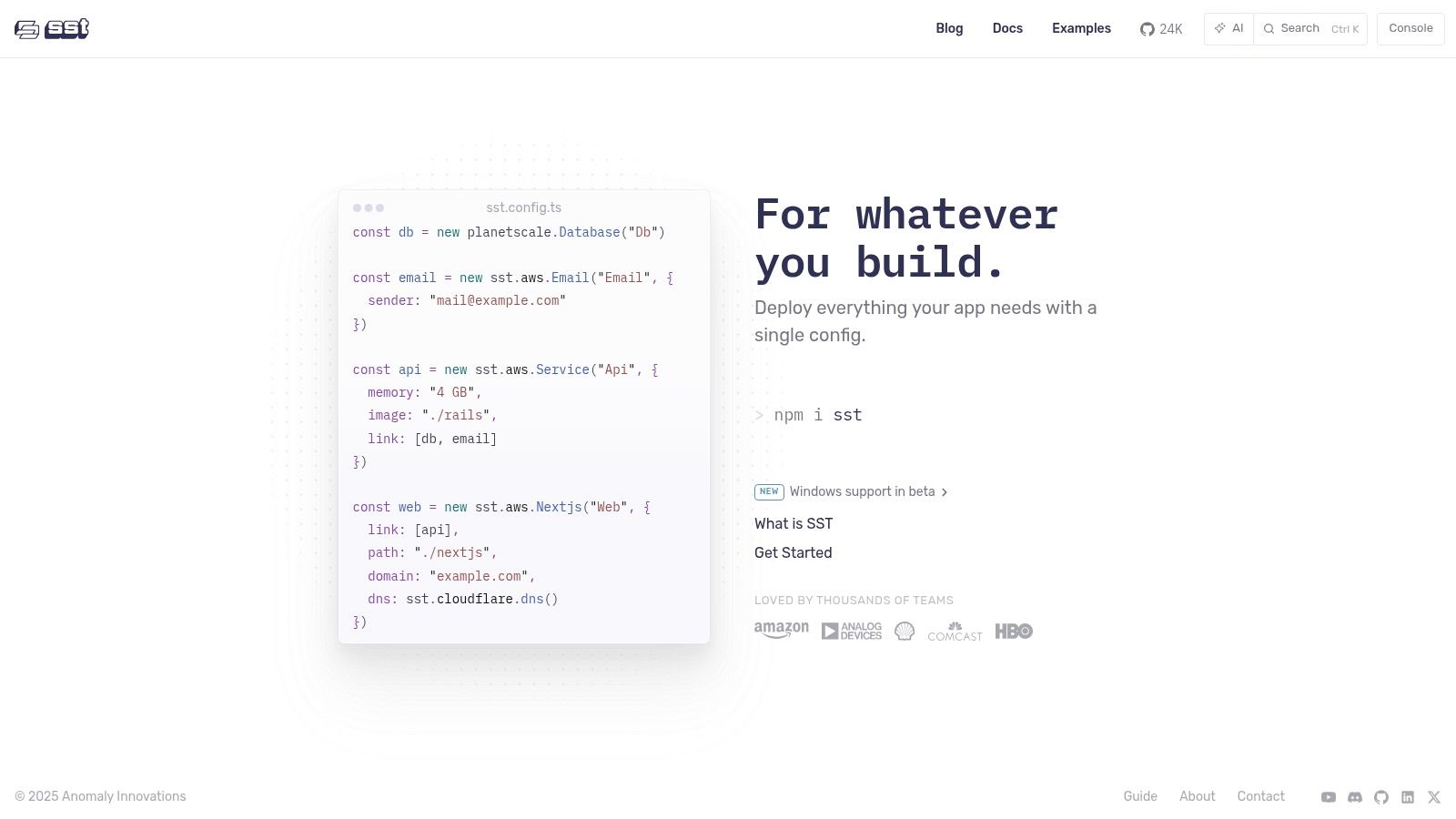
The framework's standout feature is its sst dev command, which establishes a live development environment that mirrors your production setup. This allows for near-instantaneous feedback loops by streaming Lambda invocations locally and hot-reloading code changes without redeploying. Initially built on AWS CDK, newer versions of SST now use Pulumi and Terraform, broadening its infrastructure-as-code foundation while maintaining its core focus on developer-centric workflows.
Key Details & Use Cases
- Primary Use Case: Ideal for developers and teams building full-stack serverless applications, especially those integrating modern web frontends (like Next.js or Astro) with serverless backends on AWS. Its live development environment makes it perfect for projects requiring rapid iteration and a seamless local-to-cloud workflow.
- Pricing: The core framework is open-source (MIT license) and free. SST also offers an optional, hosted SST Console for managing applications in production, which has a usage-based pricing model based on active resources.
- Maturity & Support: SST has a rapidly growing and active community, with strong documentation and a responsive team. It is well-maintained and continuously evolving, now leveraging mature IaC tools like Pulumi and Terraform for deployments.
Our Take: SST is a game-changer for full-stack serverless development on AWS. Its focus on creating a fast, enjoyable developer experience is its greatest strength, making it one of the most productive tools available for building modern web applications.
Website: https://sst.dev/
6. Architect (arc.codes)
As another strong contender among serverless framework alternatives, Architect offers a refreshingly minimalist approach to building applications on AWS. This open-source framework, governed by the OpenJS Foundation, uses a simple manifest file (app.arc) to define infrastructure. Its core philosophy is convention over configuration, which drastically simplifies the setup for common resources like HTTP APIs, queues, events, and scheduled tasks.

Architect compiles your concise manifest into a verbose and secure AWS SAM/CloudFormation template, applying least-privilege IAM policies by default. This combination of a simple developer-facing interface and a robust, secure output makes it highly approachable yet powerful. The local development sandbox provides a fast, production-like environment for offline testing, which streamlines the development workflow significantly for developers who prioritize speed and simplicity.
Key Details & Use Cases
- Primary Use Case: Ideal for developers and small-to-medium-sized teams who want the fastest possible onboarding to serverless on AWS. It excels at building web applications, APIs, and event-driven backends where a minimal configuration footprint and rapid local development are key priorities.
- Pricing: The Architect framework is completely free and open-source (Apache-2.0). You are only responsible for the costs of the underlying AWS resources that your application deploys and consumes.
- Maturity & Support: As a project within the OpenJS Foundation, Architect has a stable governance model and an active community. While its ecosystem is smaller than AWS-native tools like SAM, it is well-documented and provides a clear, focused toolset for its intended use cases.
Our Take: Architect is an excellent choice for teams that find other frameworks overly complex. Its emphasis on simplicity and secure-by-default infrastructure lowers the barrier to entry for serverless development without sacrificing the power of the underlying AWS services.
Website: https://arc.codes/
7. Claudia.js
For JavaScript developers seeking a minimal-ceremony path to AWS, Claudia.js stands out as a lightweight serverless framework alternative. It is a deployment utility designed specifically for Node.js projects, automating the tedious packaging and configuration steps required to get your code running on AWS Lambda and API Gateway. Its core philosophy is to remove boilerplate, allowing developers to deploy simple APIs and microservices with a single command.

The framework excels at abstracting away AWS complexities, letting teams leverage their existing Node.js skills and npm packages seamlessly. It handles everything from creating IAM roles to setting up API Gateway routes and managing Lambda versions, all from the command line. This focused approach makes it an excellent tool for rapid prototyping or for teams who want to build serverless functions without delving deep into infrastructure-as-code.
Key Details & Use Cases
- Primary Use Case: Best suited for Node.js developers and teams who need to quickly deploy simple, standalone APIs, microservices, or event-driven functions on AWS. It is ideal for projects where speed and simplicity are prioritized over extensive infrastructure management.
- Pricing: The Claudia.js framework is a free, open-source tool. Costs are incurred only for the AWS resources (Lambda, API Gateway) that your application uses.
- Maturity & Support: Claudia.js is a mature project with established community support and comprehensive documentation. It has a rich ecosystem of extensions and community-driven examples that cover common use cases like building chatbots and webhook handlers.
Our Take: Claudia.js provides the fastest on-ramp to AWS serverless for the Node.js community. While its narrow focus on JavaScript and Lambda/API Gateway makes it less suitable for complex, multi-resource applications, its simplicity is a major advantage for the right use case.
Website: https://claudiajs.com/
8. AWS Chalice
For Python developers, AWS Chalice is a purpose-built serverless framework alternative designed for rapid application development and deployment on AWS. This official, open-source microframework from AWS provides a decorator-based syntax that feels familiar and intuitive to anyone experienced with Python web frameworks like Flask or Bottle. Its primary goal is to abstract away the boilerplate of configuring Lambda functions and API Gateway, allowing developers to focus purely on application logic.

The Chalice command-line interface (CLI) is central to its developer experience, handling everything from project scaffolding to packaging dependencies and deploying the application. A key differentiator is its deployment flexibility; while it has its own deployment mechanism for simple use cases, it can also generate artifacts compatible with AWS SAM/CloudFormation or even Terraform. This allows teams to start quickly with Chalice and later integrate their serverless components into a more comprehensive infrastructure as code (IaC) strategy.
Key Details & Use Cases
- Primary Use Case: Ideal for Python developers building RESTful APIs, event-driven functions, or simple microservices on AWS. It excels at rapid prototyping and for projects where the simplicity of a Python-native, decorator-based framework is a priority.
- Pricing: Chalice is a free, open-source tool. You are only responsible for the costs of the AWS resources it provisions, such as Lambda, API Gateway, and IAM roles.
- Maturity & Support: As an AWS-maintained project, it has a solid foundation, good documentation, and an active community. Its ability to generate SAM and Terraform configurations adds an enterprise-grade IaC layer for more mature deployment pipelines.
Our Take: Chalice is the go-to choice for Python-centric teams that want the fastest path from code to a deployed serverless API on AWS. Its clean, Flask-like syntax makes it incredibly approachable, while its optional integration with SAM and Terraform provides a growth path for more complex, production-grade applications.
Website: https://aws.github.io/chalice/
9. Zappa (Python)
For Python developers, Zappa stands out as a unique serverless framework alternative designed specifically for deploying existing WSGI and ASGI applications to AWS. This community-driven tool essentially acts as a bridge, allowing popular frameworks like Flask and Django to run on AWS Lambda and API Gateway with minimal code changes. Its primary strength is providing a straightforward "lift and shift" path for legacy Python web apps into a serverless architecture.

The framework streamlines the entire deployment process into simple CLI commands like zappa init and zappa deploy. This rich command-line interface also handles operational tasks such as log tailing, status checks, and rolling back deployments. It cleverly packages the application, its dependencies, and a handler function that translates API Gateway events into the WSGI/ASGI format that Python web frameworks expect, abstracting away significant complexity.
Key Details & Use Cases
- Primary Use Case: Ideal for Python teams looking to migrate existing Flask, Django, or other WSGI/ASGI applications to serverless without a complete rewrite. It's also great for scheduling tasks and managing simple, event-driven workflows directly from the CLI.
- Pricing: Zappa is a free, open-source project hosted on GitHub. Costs are solely for the underlying AWS Lambda, API Gateway, and other resources consumed.
- Maturity & Support: As a community-led project, its development pace and long-term support can be variable compared to vendor-backed tools. Teams should verify its maintenance status and test it thoroughly for production use cases.
Our Take: Zappa is a powerful enabler for modernizing Python web applications. While its community-driven nature requires due diligence, its ability to quickly bring a monolithic app into a scalable, serverless environment demonstrates one of the key AWS Lambda best practices for phased modernization.
Website: https://github.com/zappa/Zappa
10. Bref (PHP on AWS Lambda)
For PHP developers looking to embrace serverless, Bref offers a highly specialized and powerful solution. It's not a direct framework replacement but an open-source project providing PHP runtimes for AWS Lambda, enabling teams to deploy familiar applications built with frameworks like Laravel and Symfony directly onto a serverless infrastructure. This focus on a single language and cloud provider allows Bref to offer unparalleled, in-depth support for the nuances of running PHP efficiently on Lambda.

Bref is designed for integration, not isolation. Instead of reinventing the wheel, it plugs directly into existing, popular deployment tools. It's most commonly used with the Serverless Framework but also provides first-class support for AWS SAM, Terraform, and the AWS CDK. This flexibility allows teams to adopt serverless PHP without overhauling their existing Infrastructure as Code (IaC) practices, making it a pragmatic choice for modernizing legacy applications or building new, scalable APIs.
Key Details & Use Cases
- Primary Use Case: Ideal for PHP development teams wanting to run their existing or new Laravel, Symfony, or custom PHP applications on AWS Lambda. It's perfect for building scalable web applications, APIs, and background workers without managing servers.
- Pricing: The open-source Bref runtimes and tooling are completely free. You only pay for the underlying AWS resources. Bref also offers an optional paid product, "Bref Cloud," which provides a deployment dashboard and further simplifies the process.
- Maturity & Support: Bref is a mature, production-proven project with a strong community and extensive documentation. It is widely regarded as the de-facto standard for running serverless PHP on AWS and is actively maintained with clear upgrade paths.
Our Take: Bref is less of a Serverless Framework alternative and more of a critical enabler. It masterfully solves the specific challenge of running PHP in a serverless context on AWS. For PHP shops, its focused approach is a significant advantage over generic, multi-language frameworks that may lack deep, language-specific optimizations.
Website: https://bref.sh/
11. OpenFaaS
For teams wanting the serverless developer experience on their own infrastructure, OpenFaaS stands out as a powerful serverless framework alternative. It is a Kubernetes-native framework designed to build, deploy, and manage serverless functions on any public or private cloud. By leveraging existing container orchestration, it offers a portable and vendor-agnostic solution for running functions, making it ideal for on-premises, hybrid, or multi-cloud strategies where data sovereignty and operational control are paramount.

The platform provides a rich developer experience with a CLI, a user-friendly Gateway UI, and a template system that supports multiple programming languages. Functions can scale to zero to conserve resources and autoscale based on metrics like requests per second or CPU usage. This self-hosted approach gives organizations full control over their FaaS platform, which is a critical requirement for air-gapped or highly regulated environments that cannot use public cloud services.
Key Details & Use Cases
- Primary Use Case: Best for organizations that need to run serverless workloads on their own Kubernetes clusters, whether on-premises or in a private cloud. It excels in scenarios requiring data residency, low-latency processing close to the source, or a consistent serverless experience across different cloud providers.
- Pricing: The core OpenFaaS framework is open-source and free (MIT License). OpenFaaS Pro and Enterprise editions are available with commercial licenses, offering advanced features like multi-tenancy, enhanced event triggers, and dedicated support.
- Maturity & Support: OpenFaaS has a mature and active open-source community. The core project is well-documented, while the commercial offerings provide enterprise-grade support, enhanced security features like OIDC authentication, and advanced queueing systems for asynchronous processing.
Our Take: OpenFaaS effectively brings the serverless paradigm to your infrastructure, but this freedom comes with operational responsibility. It's an excellent choice for teams with existing Kubernetes expertise who want to avoid vendor lock-in and gain complete control over their function execution environment.
Website: https://www.openfaas.com/
12. Netlify Functions
Netlify Functions provides a deeply integrated, managed serverless function experience for teams building web applications on its platform. Rather than being a standalone infrastructure-as-code tool, it's one of the best serverless framework alternatives for developers who want a unified, Git-based workflow that combines their frontend code, serverless backend logic, and global CDN deployment into a single, automated process. This all-in-one approach dramatically simplifies operations and accelerates time-to-market.

The core value proposition is its developer experience. By placing function code in a specific directory within a project's repository, Netlify automatically discovers, builds, and deploys it alongside the frontend assets. This Git-centric workflow includes powerful features like deploy previews for every pull request, allowing teams to test both UI changes and backend function updates in a temporary, shareable environment before merging to production. The platform also offers background functions for longer-running jobs and edge functions for logic that needs to run closer to the user.
Key Details & Use Cases
- Primary Use Case: Ideal for frontend-focused teams and Jamstack projects needing to add dynamic backend capabilities like API endpoints, form handling, or user authentication without managing complex server infrastructure. It excels in scenarios where a fast path from repository to production is the top priority.
- Pricing: Netlify offers a generous free tier with a monthly allowance of function invocations and runtime. Paid plans use a credit-based model that covers compute, bandwidth, and other platform resources, providing predictable costs as usage scales.
- Maturity & Support: As a core feature of the mature Netlify platform, Functions is well-documented and supported by a large community. The tight integration with Netlify's build system and CI/CD pipeline means there is minimal configuration required to get started.
Our Take: For teams building on the Jamstack or seeking maximum velocity, Netlify Functions is a superb choice. The operational simplicity is a huge advantage, although it comes at the cost of the low-level control and broad cloud service integration you'd find with tools like SAM or Terraform.
Website: https://www.netlify.com/products/functions/
Serverless Framework Alternatives - 12-Tool Comparison
| Tool | Core focus | Languages & platforms | Developer experience / tooling | Value & pricing | Best fit / unique strength |
|---|---|---|---|---|---|
| AWS Serverless Application Model (AWS SAM) | AWS-first serverless app framework & deployment | Any Lambda-supported language; CloudFormation-backed | SAM CLI, local debug, sam sync, CI/CD scaffolding | No extra license; pay for AWS resources only | First-party AWS integration; CloudFormation compatibility |
| AWS Cloud Development Kit (AWS CDK) | Code-first IaC that synthesizes to CloudFormation | TypeScript, Python, Java, C#, Go; AWS-only | High-level constructs (L2/L3), synth to CFN, works with SAM CLI | Free tooling; predictable CloudFormation deploys | Ideal for teams preferring general-purpose languages |
| Pulumi | Multi-cloud, code-first IaC and deployments | TypeScript/JS, Python, Go, .NET, Java; AWS/Azure/GCP | Familiar language workflows, managed state (optional), policy-as-code | OSS CLI; Pulumi Cloud adds paid features | Single tool across clouds; strong developer DX |
| HashiCorp Terraform / HCP Terraform | Declarative, vendor-agnostic IaC with large ecosystem | HCL; AWS/Azure/GCP + many providers | Module registry, stable workflows, multiple state backends (HCP) | OSS core; HCP for remote runs/governance (paid) | Widely adopted, auditable workflows and modules |
| SST (Serverless Stack) | Full‑stack serverless app toolkit with live dev | Node/TypeScript; AWS-centric (uses Pulumi/Terraform internally) | Live development, autodeploy, SST Console for logs/alerts | Core OSS; SST Console is usage‑based paid | Excellent local dev & iteration for modern web stacks |
| Architect (arc.codes) | Manifest-driven, minimal AWS serverless framework | AWS Lambda; compiles to SAM/CloudFormation | Simple app.arc manifest, local sandbox, least‑privilege IAM | Apache-2 OSS; lightweight | Fast onboarding for small-to-medium AWS serverless apps |
| Claudia.js | Fast deploys for Node.js to Lambda/API Gateway | Node.js only (npm ecosystem) | Single-command deploy/update, versioning, simple CLI | OSS; minimal overhead | Very low learning curve for JavaScript teams |
| AWS Chalice | Python-first framework for Lambda APIs & events | Python; can emit CFN/SAM/Terraform artifacts | Pythonic CLI, easy REST API creation, rapid iteration | First-party OSS; no extra cost | Best for Python teams needing rapid Lambda APIs |
| Zappa (Python) | Deploy WSGI/ASGI Python web apps to Lambda | Python (Flask, Django, etc.) | zappa init/deploy, log tailing, scheduled tasks support | Community OSS; verify long‑term maintenance | Lift legacy Python web apps to serverless quickly |
| Bref | PHP runtimes & tooling for AWS Lambda | PHP (Laravel, Symfony) on AWS Lambda | PHP runtimes, examples, cost calculator, SDKs | OSS core; optional Bref Cloud managed product (paid) | Practical path for PHP teams modernizing to Lambda |
| OpenFaaS | Serverless functions on Kubernetes / self-hosted infra | Any language via templates; Kubernetes, CRDs | CLI, gateway UI, scale-to-zero, event triggers, observability | OSS core; enterprise features paid | Run serverless on your clusters for air‑gapped/regulatory needs |
| Netlify Functions | Managed functions integrated with Netlify hosting & CDN | JavaScript, Go, and platform-supported runtimes | Git-based workflow, previews, global CDN, simple CI/CD | Usage-credit model on paid tiers; predictable billing | End-to-end host+functions for web teams with minimal ops |
Making the Right Choice for Your Next Project
Navigating the landscape of serverless framework alternatives can feel overwhelming, but the journey is less about finding a single "best" tool and more about aligning a specific solution with your unique project requirements, team skillset, and long-term vision. The Serverless Framework set a powerful precedent, but as we've explored, the ecosystem has matured dramatically, offering specialized tools that cater to distinct needs and philosophies.
The central takeaway is that your choice of framework is a strategic decision that directly impacts developer productivity, operational overhead, and architectural flexibility. There is no one-size-fits-all answer; the optimal choice is deeply contextual.
Key Considerations for Your Decision
As you evaluate the options presented in this article, anchor your decision-making process around these critical factors:
- Team Expertise and Language: The most significant factor is your team's existing knowledge. If your developers are TypeScript experts who thrive on programmatic control, tools like AWS CDK, Pulumi, and SST will feel like a natural fit. Conversely, a team well-versed in Python or Go might gravitate towards Chalice, Zappa, or using Terraform for a unified infrastructure-as-code approach.
- Cloud Strategy (Single-Cloud vs. Multi-Cloud): Is your organization committed to a single cloud provider like AWS, or do you require a multi-cloud or hybrid strategy? This is a fundamental branching point. For deep AWS integration, AWS SAM and CDK are purpose-built and highly optimized. For managing resources across AWS, Azure, and GCP, Terraform and Pulumi are the undisputed leaders in multi-cloud orchestration.
- Developer Experience (DX) vs. Operational Control: Prioritizing a seamless, fast-feedback development loop? Frameworks like SST and Architect are designed from the ground up to optimize for this, with features like live lambda development and integrated testing. If your primary need is granular control, policy enforcement, and fitting into a broader GitOps workflow, Terraform or Pulumi will provide the robust operational capabilities you require.
- Project Scope and Abstraction Level: Are you building a simple, function-first backend, a full-stack application, or managing complex, interconnected cloud infrastructure? A simple API might be perfectly served by Claudia.js or Netlify Functions. A full-stack application with a Next.js or SvelteKit frontend will benefit immensely from SST's integrated constructs. Large-scale enterprise systems often require the low-level power offered by Terraform.
A Final Thought on Your Serverless Journey
Choosing a framework is not just a technical selection; it's an investment in your team's workflow and your application's future. The right tool will act as a force multiplier, accelerating development and simplifying maintenance. The wrong tool can introduce friction, steep learning curves, and long-term technical debt.
Embrace this decision as an opportunity to critically assess your priorities. By thoughtfully balancing developer experience, operational needs, and strategic goals, you can confidently select one of the many capable serverless framework alternatives and build a scalable, resilient, and efficient application. Your next project's success begins with this foundational choice.
Navigating this complex decision matrix can be challenging. For organizations seeking expert guidance to de-risk their technology choices and accelerate their cloud-native adoption, Pratt Solutions offers specialized consulting. We help you select and implement the ideal serverless framework that aligns perfectly with your business objectives and ensures long-term architectural success.